VMFT’s pilot project shows the need to develop innovative approaches
Imagine a student in Grade 5 who cannot read at text at their level, fluently and with comprehension. How would such a student progress in school and in life, acquire more knowledge, skills and critical thinking in our increasingly information rich world? A staggering 70% of 10-year-olds in lower and middle income countries cannot read and understand a simple, age-appropriate text, according to some international estimates.
If you think the state of Kerala, arguably the best achiever amongst Indian states, does not face this problem, think again. Even before the pandemic approximately 33% of rural Grade 5 students could not read a simple text at the Grade 2 level in either English or Malayalam. The problem starts earlier: two-thirds of rural Grade 2 students and half of Grade 3 students were similarly unable to read a simple passage. This is based on ASER data (https://asercentre.org); on a survey of rural children conducted annually.
Check our report: https://vmft.org/wp-content/uploads/2025/02/VMFT-Separate-Unequal-Final-Web-Pages_compressed.pdf.
No doubt the situation has become much worse since the pandemic, when schools were closed for almost two years.
Bilingual Reading Program– a field project aiming for impact and scalability
Part of the problem in states like Kerala is that children acquire oral proficiency in Malayalam but many of them are studying in “English medium”, a language in which they do not have the oral repertoire. The education system has not addressed the issue of how to teach in two languages in contexts such as Kerala’s, which is also similar to that of many other Indian states, as well as other low and middle income countries. Reading and language, even in the mother tongue, are often not taught in a structured and meaningful way in most schools across the state. When teaching in English, teachers often rely on rote learning, memorization, and copying prepared texts, failing to teach students how to actually read, think, or understand the language systematically.
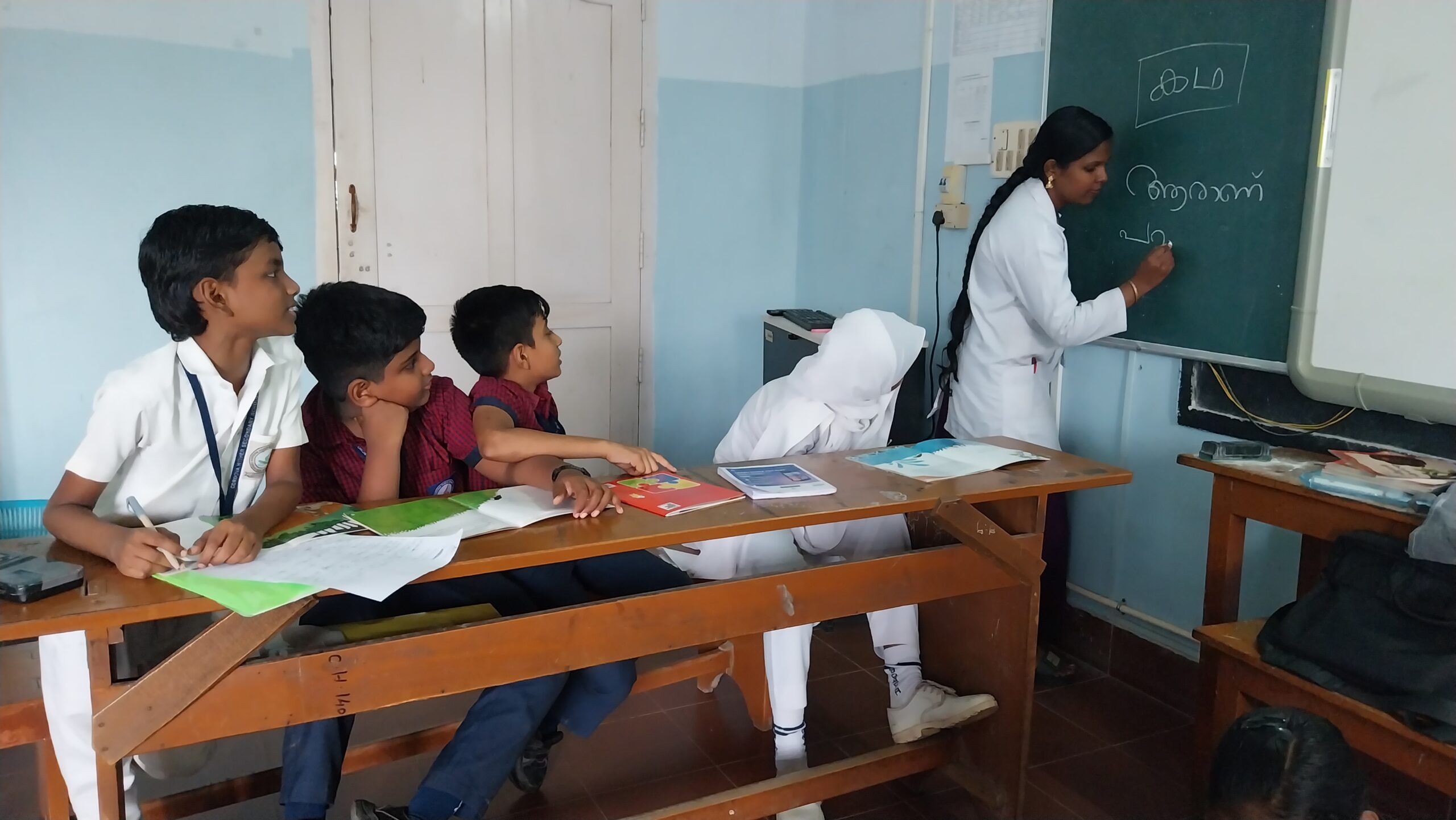
VMFT’s Bilingual Reading Instruction Program, organized as a remedial program for Grade 5 students, which can be implemented by schools or community organisations tries to develop a structured model to enable students to read with comprehension. Grade 5 is a crucial milestone for students, where they must shift from “learning how to read” to “reading to learn”. The program is being implemented in two coastal communities in Trivandrum district. The initiative has three main objectives:
- Help students to enjoy and learn reading in both English and Malayalam
- Provide proof of success by collecting a variety of information
- Create a model that works: To develop a structured, replicable, and cost-effective program model that can be easily scaled up for use in more communities and schools in the future.
Stories: The beginning of reading for pleasure
The program is based on a fundamental principle: children love stories and if reading becomes pleasurable, because they understand the story, they will learn to read on their own. At its core, reading is about comprehension. In addition, children have to be explicitly taught reading strategies, so that they can apply these strategies to new texts, including texts that provide information, textbooks and so on.

VMFT selected levelled story books in English and Malayalam, with increasing complexity of language. Each story is covered in 2-3 lessons each. An English story is followed by a Malayalam story and so on. The program was originally designed for 60 lessons, but has been shortened to about 48, due to school absences.
Two trained facilitators, one with primary responsibility for English lessons and the other for Malayalam lessons, follow structured lesson plans organized around the story. Activities include oral storytelling, encouraging students to read on their own, answer comprehension questions, pose questions, identify words they do not understand, engage in drawing pictures, role playing and so on. Facilitators are supported through weekly sessions to review their teaching and identify issues, as well as adjust the program or stories.
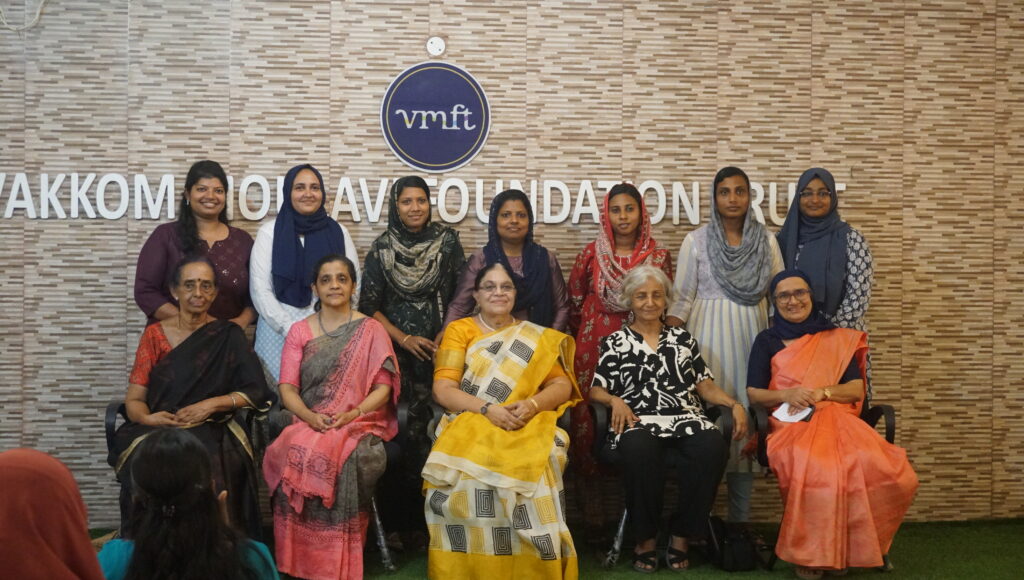
Here are our dedicated facilitators:
https://www.linkedin.com/feed/update/urn:li:activity:7402325485571018752
https://www.linkedin.com/feed/update/urn:li:activity:7388812509773889537
Sound pedagogical principles
The program’s core pedagogical rationale is that children in Kerala naturally reason and think bilingually in their daily lives. The program is specifically designed to leverage this capacity by treating English and Malayalam as complements to one another, rather than as separate or competing subjects. This methodology is based on:
Cross-linguistic Transfer: The principle that skills gained in one language (e.g., a strong foundation in Malayalam) can accelerate learning and comprehension in a second language (English).
Scaffolded Comprehension: Providing targeted support to help students engage with and understand texts that are slightly above their current competency level, thereby continuously building confidence and skills.
These principles are mentioned in many policy documents but translating them into practice has proved very difficult.
Data for monitoring progress and assessing impact
Many pilot programs in education lack rigorous monitoring and feedback system, as well as data to see whether the intended results are being achieved. The project measures student progress through independent learning assessments administered at three points: baseline (start), midline (middle), and endline (close of the program). Regular, structured observations and video recordings are used to provide feedback to facilitator, who also keep a record of students’ attendance, progress and formative assessments.
Education for the future requires children to think critically and become lifelong learners – reading comprehension is the first step in this journey.