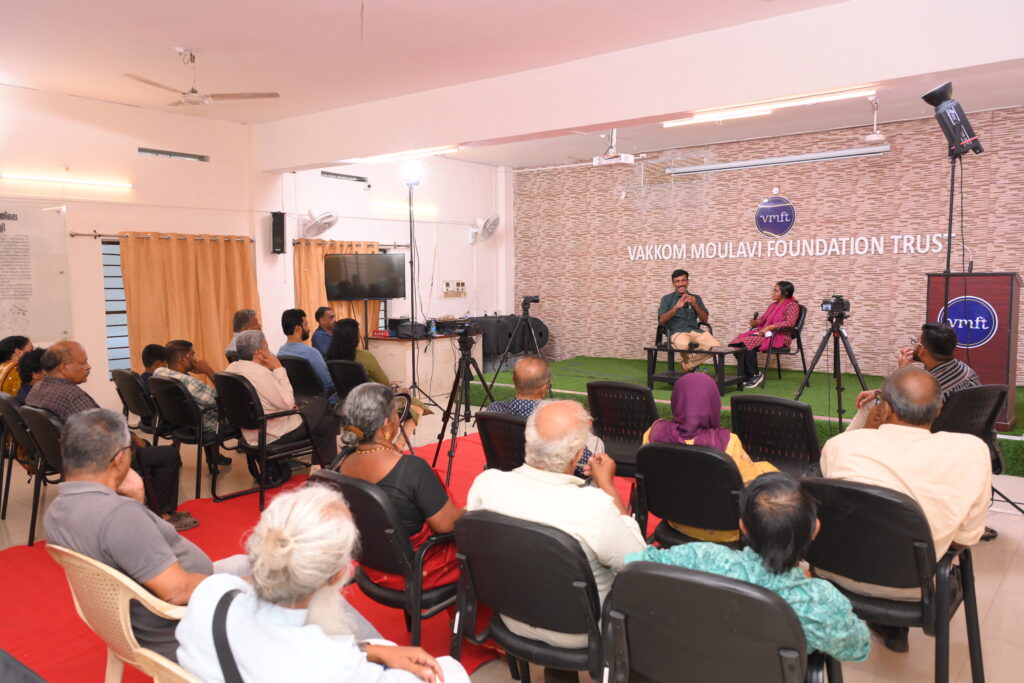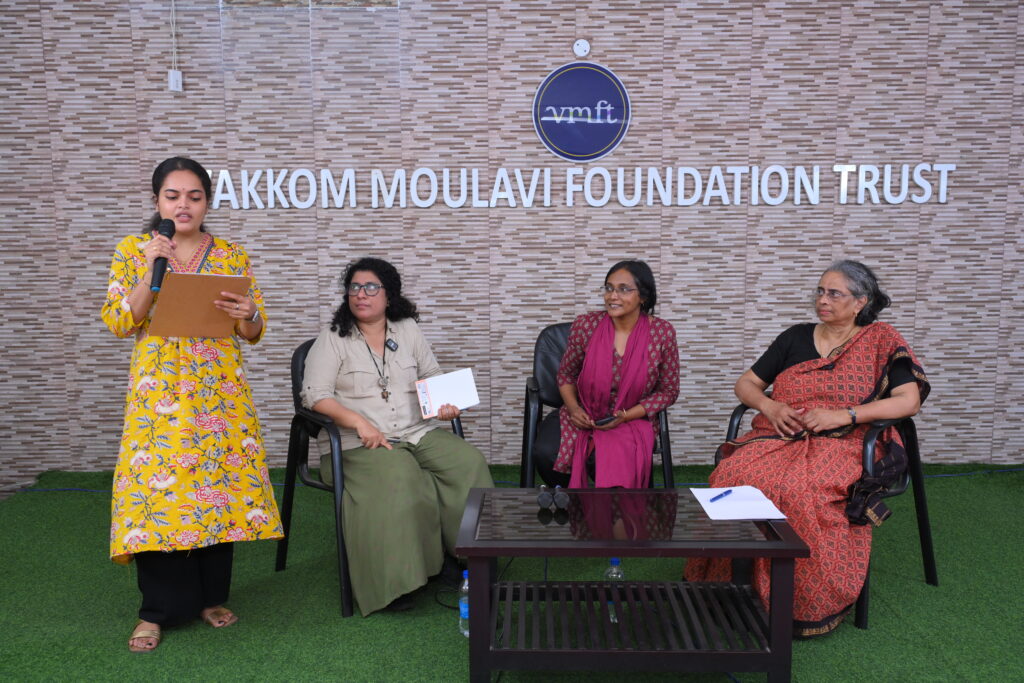
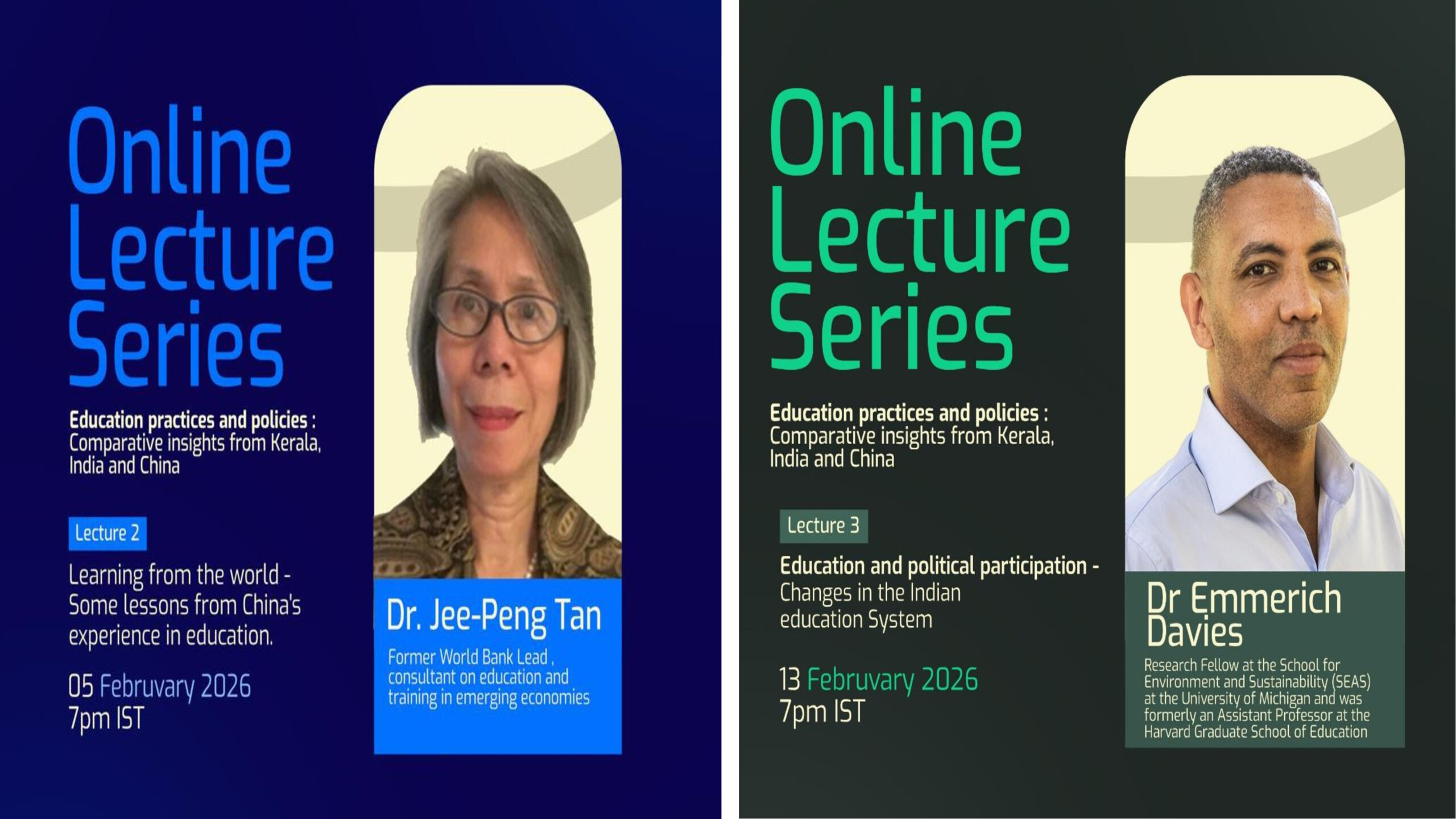
The Vakkom Moulavi Foundation Trust (VMFT), in collaboration with the School of Gandhian Thought and Development Studies, continued its Learning from the World – Online Lecture Series in February 2026 with two deeply insightful sessions that examined education systems through complementary global and domestic lenses. Held on February 5, 2026 and February 13, 2026, the sessions featured Dr. Jee-Peng Tan, Former World Bank Lead, consultant on education and training in emerging economies, and Dr. Emmerich Davies, Research Fellow at School for Environment and Sustainability (SEAS), University of Michigan & former Asst. Professor, Harvard Graduate School of Education, respectively, and offered a rich, comparative understanding of how education systems evolve, perform, and shape societies.
The first session, delivered by Dr. Jee-Peng Tan, focused on drawing lessons from China’s experience in education reform. Framing education as a lifelong, cumulative process rather than a series of disconnected stages, the talk emphasized the importance of building a strong and coherent “pipeline” that supports learners from early childhood through adulthood. China’s success, as highlighted in the lecture, lies in the strength of this pipeline, which has enabled the country to expand higher education rapidly while maintaining continuity in learning outcomes. The discussion underscored that such systemic strength is not accidental but the result of deliberate policy choices, sustained investment, and a clear prioritization of education within national development.
A central pillar of China’s approach is its treatment of teachers as critical assets within the education system. The lecture detailed how structured career pathways, rigorous accreditation systems, and continuous professional development contribute to a highly सक्षम teaching workforce. Particularly noteworthy is the long-standing practice of “teaching research” or Jiaoyan, a collaborative model where teachers regularly engage in peer learning, lesson observation, and instructional improvement. These teaching research groups function as embedded professional learning communities within schools, ensuring that teaching practices are continuously refined and aligned with evolving educational needs. This focus on improving classroom practice, rather than relying solely on top-down reforms, has been described as one of the most valuable and distinctive features of China’s education system.
The session also highlighted the role of strategic partnerships, including China’s engagement with the World Bank, in accelerating reform. External expertise was leveraged not as a substitute for domestic capacity but as a catalyst to strengthen it. The emphasis remained on building institutional capability, fostering learning organizations, and ensuring that reforms were both scalable and sustainable. Importantly, the lecture distilled key principles for successful reform: anchoring change in a shared vision, prioritizing goals, sequencing interventions carefully, and scaling innovations through collaboration and knowledge-sharing.
The second session, delivered by Dr. Emmerich Davies on February 13, shifted the focus to India’s education system, offering a political economy perspective on its evolution from 1980 to 2026. The analysis traced the remarkable expansion of education in India, particularly at the primary level, where access has moved from being limited and uneven to nearly universal. However, this expansion has been accompanied by a significant structural shift: the growing role of private provision and a corresponding rise in out-of-pocket expenditure. Where education in the mid-1980s was largely publicly funded and accessible at minimal cost, the contemporary system reflects a mixed model in which private institutions account for a substantial share of provision.
This transformation, the lecture argued, has had far-reaching implications for equity and social outcomes. While literacy levels and basic learning indicators have improved over time, these gains remain uneven across regions, social groups, and income levels. The increasing reliance on private education has enabled wealthier households to opt out of the public system, thereby weakening the political and financial commitment to public education. As a result, those who depend most on government schools, primarily the middle and lower-income groups, often face constraints in quality and access.
Dr. Davies’ analysis framed education not only as a tool for individual advancement but also as a site of social and political contestation. Drawing on multiple theoretical perspectives, the lecture highlighted how education can enable social mobility, enhance economic efficiency, foster democratic participation, expand individual capabilities, and serve as a means of social liberation. At the same time, it pointed out that education redistributes opportunities and power, which can lead to resistance from entrenched interests. The dynamics between different socio-economic groups, particularly the ability of elites to exit public systems, play a crucial role in shaping policy priorities and outcomes.
The discussion also examined the impact of large-scale policy initiatives aimed at expanding access, such as district-level education programs and community-based interventions. While these efforts have contributed to increased enrollment and participation, their effects on social relations and perceptions of education have been complex. In some contexts, gains in access have not translated into sustained improvements in quality or public confidence, highlighting the challenges of balancing rapid expansion with long-term system strengthening.
Taken together, the two sessions offered a compelling comparative perspective. China’s experience illustrates the benefits of a coordinated, state-led approach that prioritizes system coherence, teacher development, and continuous learning within institutions. India’s trajectory, by contrast, reflects the tensions inherent in a rapidly expanding system operating within a diverse and stratified society, where public and private roles are continually being renegotiated.
The juxtaposition of these perspectives underscores a shared insight: the effectiveness of an education system depends not only on access or scale but on the alignment between policy, institutions, and societal commitment. Strong systems are built through sustained investment in foundational elements, clear strategic direction, and mechanisms that enable continuous improvement. At the same time, ensuring equity requires maintaining the centrality of public education and addressing the structural factors that drive fragmentation.
Through these two lectures, the series reinforced its core objective of fostering informed dialogue on education by bringing together global lessons and local realities. The discussions highlighted that while there is no single model to replicate, there is much to learn from comparative experiences, especially in understanding how systems can be designed to deliver both quality and equity in a rapidly changing world.