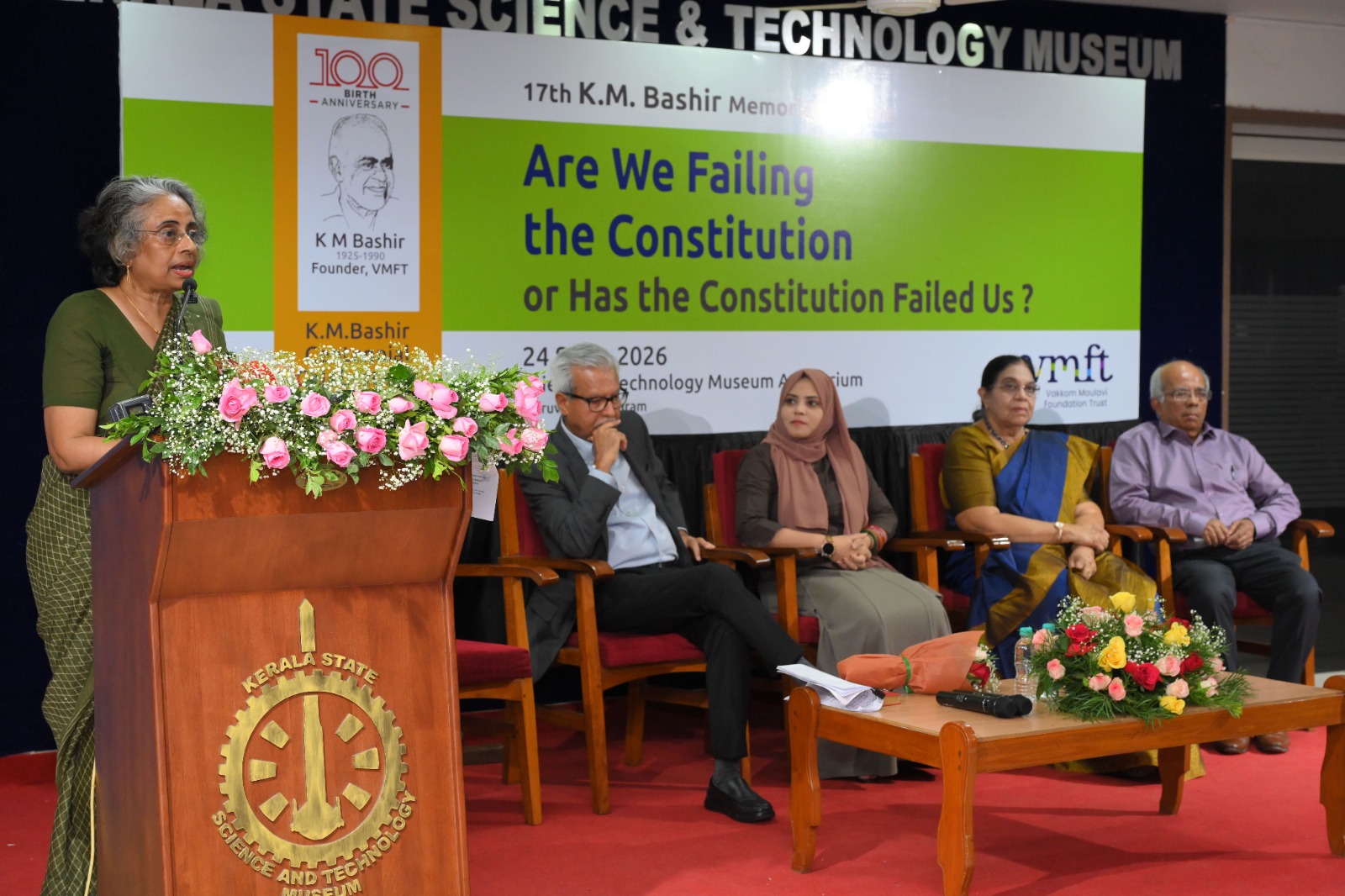
For Dr Sajitha Bashir, democracy has always meant more than the right to vote. It is about how we live with one another, how we respond to inequality, and whether we make space for people to participate in shaping the society they belong to. These ideas were central to the life and work of her father, K. M. Bashir, and continue to inform the work of the Vakkom Moulavi Foundation Trust (VMFT).
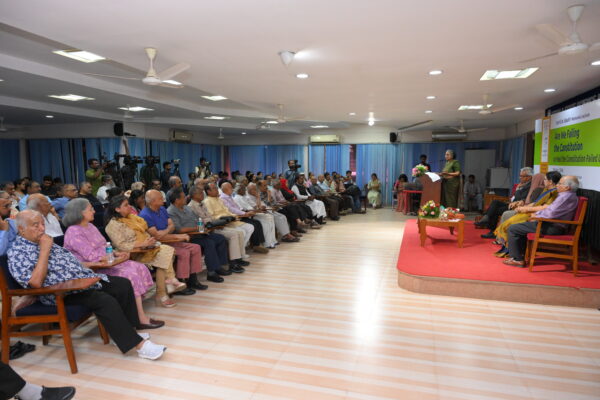
Speaking at the 17th K. M. Bashir Memorial Lecture, Dr Sajitha reflected on the ideas that shaped her father’s worldview and the principles behind the institution he helped establish. Her remarks offered a reminder that the values of democracy and citizenship cannot be sustained by institutions alone. They also depend on the choices people make in their everyday lives.
Learning to live democracy
Born in 1925 in a small village in South Travancore, K. M. Bashir grew up in a society marked by caste-based inequality and restrictions on basic freedoms. Access to education was limited for many, and social position determined what people could do, where they could go and how they could live.
Against this backdrop, he became the first person in his family, village and community to attend college and complete a postgraduate degree in mathematics and statistics. He was 22 when India became independent.
For Dr Sajitha, this context is important to understanding her father’s idea of citizenship. Having witnessed the consequences of inequality, he believed that a democratic society could not be built simply by introducing democratic institutions. People had to learn to participate in it.
That learning begins long before a person enters a polling booth. It happens at home, in schools, at work and in communities, wherever people learn to listen to others, disagree, participate and live with differences. Democracy, in this sense, is not just a form of government. It is a way of life.
Progress cannot be an individual pursuit
Three principles ran through K. M. Bashir’s thinking and the institution he envisioned.
The first was that communities could not progress in isolation. The advancement of one group meant little if others continued to face exclusion. Equality and human dignity had to be part of the larger idea of development.
The second was his belief in the power of ideas to change society. But ideas could not remain confined to intellectual circles or academic discussions. For them to make a difference, they had to reach ordinary people and engage with the questions that shaped their lives.
The third was a sense of responsibility towards society. Those who benefit from its opportunities have an obligation to give something back. For K. M. Bashir, building institutions was one way of making that contribution last beyond an individual lifetime.
These principles helped shape VMFT. Its founding drew on several intellectual traditions, including Kerala’s social reform movements, the national liberation struggle, socialist and anti-colonial thought, and Islamic modernist ideas. Together, these influences informed a vision that placed knowledge, scientific inquiry and social responsibility in conversation with one another.
Building institutions that outlast individuals
VMFT was not conceived as an extension of a religious organisation, business group or political party. Nor was it intended to be only an academic institution, an activist organisation or a provider of welfare. Its purpose was to bring knowledge and scientific inquiry to the questions facing society while remaining connected to the lives of ordinary people.
This vision also connects closely with VMFT’s focus on Inclusive Governance, which seeks to strengthen democratic values, encourage informed participation and make governance more equitable. By creating spaces for dialogue and critical engagement, VMFT works to bring the principles of citizenship, equality and social responsibility into public life.
Dr Sajitha’s reflections also placed this legacy in the present. At a time when hatred and incitement to violence threaten social cohesion, the values of equality and human dignity need renewed attention. These are not ideas alien to Kerala’s history. They are part of the state’s own social reform tradition, shaped by people who challenged exclusion and expanded the meaning of citizenship.
The work of citizenship continues
Remembering K. M. Bashir, then, involves more than preserving his memory or the institution he helped create. It means asking how his ideas can continue to find expression in society.
The Constitution provides a framework for justice, liberty, equality and fraternity. But these principles acquire meaning through how institutions function and how citizens treat one another. They require participation, a willingness to engage across differences and a commitment to ensuring that progress is shared.
Dr Sajitha’s address brought the discussion back to this responsibility. The task is not simply to inherit the work of those who came before us, but to participate in it, strengthen it and make it relevant to the future.
Democracy cannot be sustained by constitutional principles on paper alone. It must be practised in the way we live, the institutions we build and the society we choose to create together.
Watch the full event here: https://youtu.be/i21BtmdRrtI?si=PaL7pndQ3XeMZx50
Speech by Dr. Sajitha Bashir: https://youtu.be/Wf_4Yn6SgFU?si=2UsTsYxqWw9wP43y